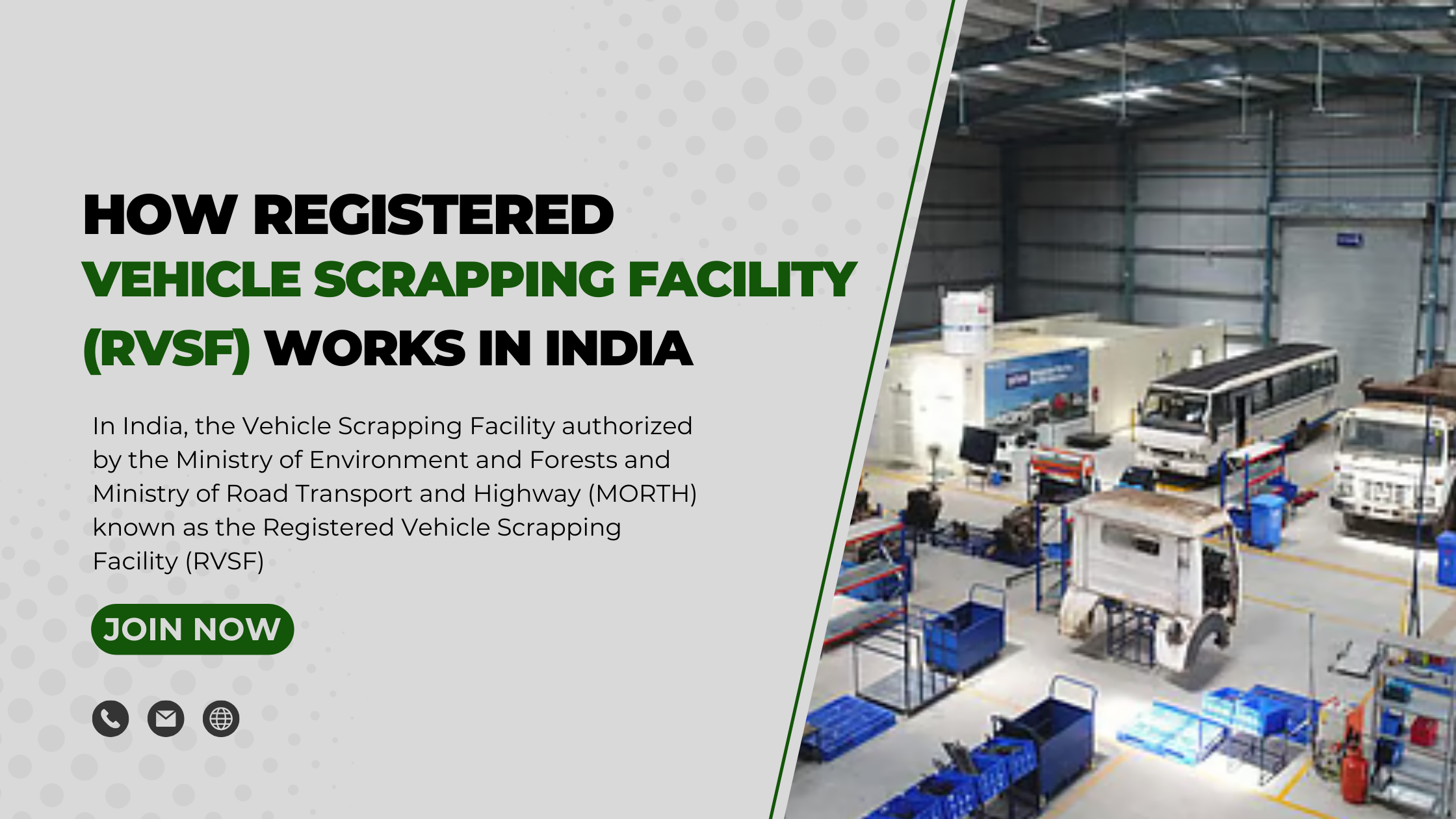
How Registered Vehicle Scrapping Facility (RVSF) works in India
08 Jan 2026 | EnviroXperts TeamIn India, the Vehicle Scrapping Facility authorized by the Ministry of Environment and Forests and Ministry of Road Transport and Highway (MORTH), known as the Registered Vehicle Scrapping Facility (RVSF), was introduced in 2020.

- Consent
from PCB
- Annual
Return Filing
- Complete Documentations
- Company
Registration
Overview
In India, the Vehicle Scrapping Facility authorized by the Ministry of Environment and Forests and Ministry of Road Transport and Highway (MORTH), known as the Registered Vehicle Scrapping Facility (RVSF), was introduced in 2020. Initially, this facility and licensing system was implemented on a state-specific basis. Under this policy, it was stated that all vehicles older than 15 years should be scrapped to reduce waste across India. Through this process, scrap materials can be segregated and, after being handed over to authorized recyclers, transformed into different forms as per manufacturers’ requirements.
Basic requirements to setup RVSF facility
Under the RVSF policy, it was further stated in 2024 that anyone intending to set up such a plant must have a minimum of two acres of land within the respective state. The land may be in an industrial area or classified as non-agricultural land. To operate as a Registered Vehicle Scrapping Facility, the operator must possess the necessary machinery, which must be demonstrated during inspection. This includes cutters, shredders, or balers for dismantling vehicles. In addition, the facility must be equipped with lift checks and air pollution monitoring and control devices. Under the Vehicle Scrapping Policy, approvals must be obtained from the State Pollution Control Board and the Ministry of Road Transport and Highways. Furthermore, detailed basic reports and management plans must be prepared.
Business opportunities in RVSF
The RVSF license provides significant business opportunities in India, especially for young entrepreneurs and others. An RVSF facility acts as a centralized hub where various types of scrap can be collected. For example, when a vehicle is processed at an RVSF facility, materials such as aluminium, iron, copper, steel, rubber, glass, silencers, tires, oil and other components are segregated and sent to authorized recyclers. This process enables waste to be collected and segregated at a single location. The collected scrap is then sold to authorized recyclers, reducing the difficulty they face in sourcing and collecting waste.
The facility plays a vital role in the recycling ecosystem. Recyclers can use the scrap received from RVSFs to manufacture various products through processes such as ingot production or injection moulding, depending on manufacturers’ requirements.
Waste management Under RVSF
Under the RVSF guidelines, it is mandatory to maintain complete records of all waste generated after scrapping, dismantling, or cutting vehicles. According to the rules revised in February 2024 by the Ministry of Environment, Forest and Climate Change and the Central Pollution Control Board, the government is authorized to audit the plant every six months. During inspections, authorities may request detailed information regarding the type of scrap generated and the recyclers to whom it was sent.
Under the RVSF policy, ship waste will also be added in the upcoming days, as it is essentially a movable vehicle. Therefore, according to the Ministry of Environment and Forests, ship waste can also be collected through the RVSF facility and after proper dismantling can be sent to the authorized recyclers in the future.
The ship waste addition in RVSF policy will surely help in generating revenue in terms of GST collection, and helps recyclers also in getting the accurate scraps for more production of raw material which help in development of infrastructure in our country.
How RVSF Plays major role to maintain ecosystem
Pollution is increasing day by day in our country, and the RVSF initiative is a positive step taken by the Indian government to address this issue while benefiting manufacturers. As responsible citizens, it is our duty not to accumulate scrap irresponsibly. When scrap is routed to recyclers through RVSF facilities, the applicable taxes are paid to the government. Additionally, when recyclers manufacture products from this scrap and sell them to manufacturers, GST is collected on those transactions as well. This creates a system where effective waste management contributes to GST revenue, which the government can utilize for the future development of the country.
How can Enviroxperts help you?
You can connect with Enviroxperts regarding consulting services for environmental compliance. You can contact us for any type of documentation or filing related matters. We will provide you with end-to-end consulting solutions for waste management
Related Blogs
Who are Enviroxperts and How They Help Businesses with Environmental Compliances?
Read More
How to Get an E-Waste License in India? A Complete Guide
Read More
Complete Guide to EPR Registration in India
Read More
How to Import Scrap Batteries in India and its Rules, License & Compliance Guide
Read More
How Registered Vehicle Scrapping Facility (RVSF) works in India
Read More
What EPR E waste Management rules says
Read More
What Tyre Waste Management Rules Says
Read More
What is EPR Battery
Read More