
- Consent
from PCB
- Annual
Return Filing
- Complete Documentations
- Company
Registration
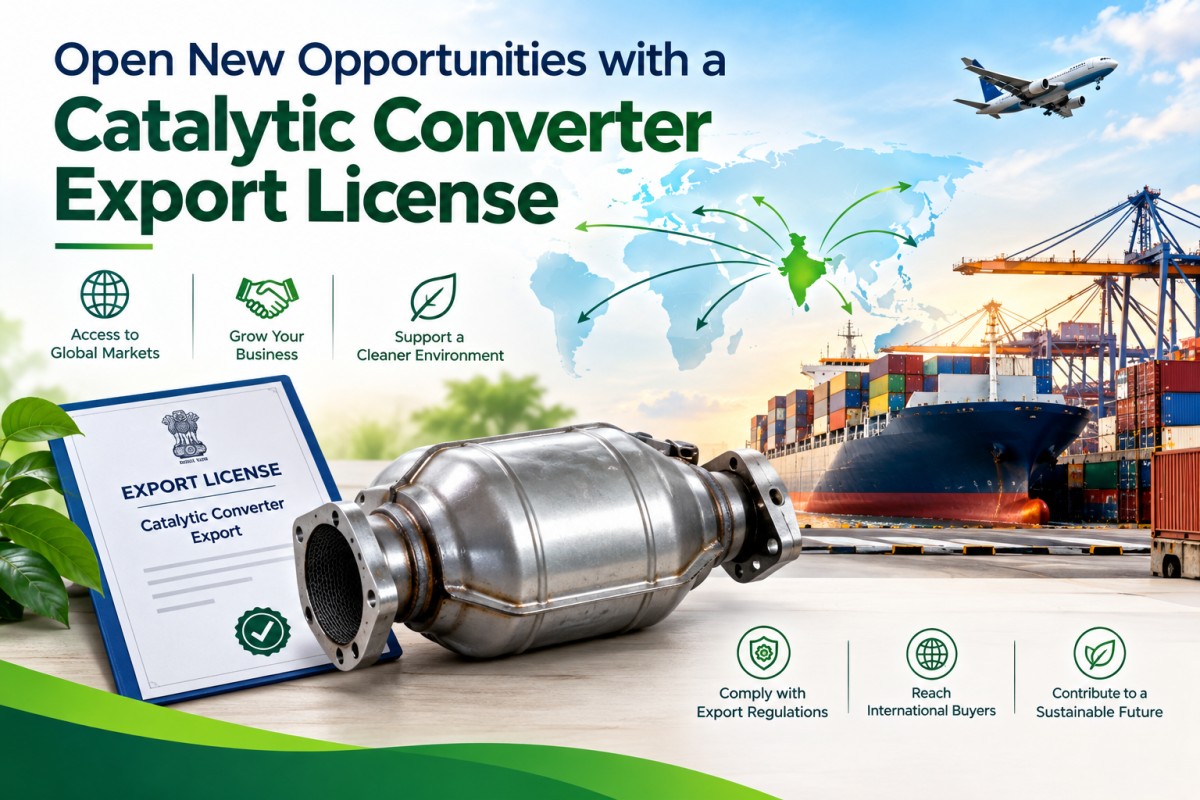
Exhaust systems in cars, trucks, and other automobiles contain precious metals like platinum, palladium, and rhodium. These metals are of very high value but could end up as waste materials if not recovered, restored, and reused properly. Recycling facilities need a valid Catalytic converters export license to export converters and generate attractive returns.
In the international market, catalytic converters are classified as hazardous waste. These need very efficient handling and, with a valid licence, can be exported for reuse in new products. Businesses in the recycling sector need a clear understanding of the documentation, like licensing, approvals, and compliance, needed in the export of catalytic converters.
What are catalytic converters?
Platinum, palladium, and rhodium are three of the six PGM (platinum group metals) with catalytic properties. Platinum group metals are used in the automotive and chemical industries to speed up chemical reactions. Platinum, palladium, and rhodium are present in the spent catalyst of the catalytic converters of automobiles. These are used to reduce harmful emissions like carbon monoxide to less harmful carbon dioxide from the exhaust system.
Once the life of the exhaust system is over, spent catalyst can be exported to recover PGM metals for alternative use in various industries. Platinum catalysts are used in the petroleum refining and chemical processing industry. The primary metals recovered from catalytic converters are platinum, palladium, and rhodium. PGM metals are rare and fall under the nonferrous metals category; hence, they are actively exported.
What documents are required for a catalytic converter export license?
A catalytic converter export license is a mandatory document for recyclers, traders or businesses dealing in the export of catalytic converters. Licenses for export are managed as per the guidelines from the MoEFCC (Ministry of Environment, Forest and Climate Change). It is stated that all applications for the export of hazardous material are accepted through the NSWS (National Single Window System) portal for business approvals.
All the compliances regarding the export of catalytic converters are regulated under the Hazardous and Other Wastes (Management and Transboundary Movement) Rules, 2016, commonly called the HOWM Rules, 2016. Proper documentation is recommended for both buyers and sellers during audits, inspections, or investigations.
Businesses dealing in the export of catalytic converters must have the following documents:
- Registered business ID proof
- Permission certificate issued by MoEFCC
- CTO issued by SPCB
- Basel compliance
- Restricted Export License
- Import Export Code (IEC) issued by DGFT (Directorate General of Foreign Trade)
- Buyer-seller agreement
- Pre-shipment inspection agreement
Why start a catalytic converter export business in 2026?
The recycling business has numerous benefits apart from building a sustainable future. The automobile industry is rapidly growing, and the honeycomb ceramic inside the Catalytic converter of the exhaust system in any vehicle offers a wide range of economic, operational, and environmental benefits for companies.
1. Sustainability
Without the export facility, most of the precious metals from the PGM group may end up as waste. Exporting the catalytic converter boosts revenue and reduces the load of hazardous substances from the environment.
2. Better circular economy
Precious metals are non-renewable and, once depleted, can't be renewed for millions of years. Recovery and reuse of these metals benefit the circular economy.
3. Complete regulatory compliance
Businesses with all the necessary approvals face no penalties or cargo rejection. Your focus demonstrates company responsibility and builds agreement with regulators and clients.
5. Better operational performance
Businesses dealing in the export of catalytic converters maintain a high-quality export vision. These businesses have an operational layout and execute as per the plan. This approach improves the handling of the hazardous metal and strengthens the overall operational performance.
Precautions for the export-Import of a catalytic converter:
All the businesses involved in the export-import of the converters must consider a few factors before making a deal. Catalytic converters are managed under the guidelines of Hazardous and Other Wastes (Management and Transboundary Movement) Rules, 2016, commonly called the HOWM Rules, 2016. Catalytic converters fall under the hazardous metal category and need extreme precaution before exporting.
- There should be proper handling
- Must satisfy the Basel classification
- Used/spent converters require approval from MoEFCC.
Conclusion
Environmental awareness has made businesses pay extra attention while exporting or importing any kind of hazardous material. With valid approvals, recycling facilities can export catalytic converters. To secure a valid import-export code (IEC) and other mandatory documentation, EnviroXperts provide exceptional support.
Given the list of mandatory documents listed under MoEFCC, approvals become easy with EnviroXperts. We are an e-waste management consultancy providing comprehensive support to recyclers, traders, businesses, and startups.
Boost your business and get better revenue with EnviroXperts.
Are you stressed about catalytic converter exports? Get complete support on all the documentation and approvals from EnviroXperts.
Contact us for detailed documentation requirements.
FAQ for Enviroxperts
-
Q. Who is eligible to start a catalytic converter export business?
Answer:- All kinds of vehicle manufacturers, automobile dismantlers, recyclers, or buyers with valid IEC from DGFT, MoEFCC approvals, and SPCB approvals can export these materials.
-
Q. Which material is not in the export list of catalytic converters?
Answer:- Radioactive components can be exported.
-
Q. What is the average duration required to get all the necessary approvals?
Answer:- The timeline for all the approvals depends upon the accuracy of the application and the submission of the mandatory documents. Your application must follow all the guidelines stated by the MoEFCC, SPCB, and the Basel Convention rules. Typically, it can take 3 weeks to 3 months, depending on the correctness of the documents attached.
Related Blogs
Who are Enviroxperts and How They Help Businesses with Environmental Compliances?
Read More
How to Get an E-Waste License in India? A Complete Guide
Read More
Complete Guide to EPR Registration in India
Read More
How to Import Scrap Batteries in India and its Rules, License & Compliance Guide
Read More
How Registered Vehicle Scrapping Facility (RVSF) works in India
Read More
What EPR E waste Management rules says
Read More
What Tyre Waste Management Rules Says
Read More
What is EPR Battery
Read More