
- Consent
from PCB
- Annual
Return Filing
- Complete Documentations
- Company
Registration
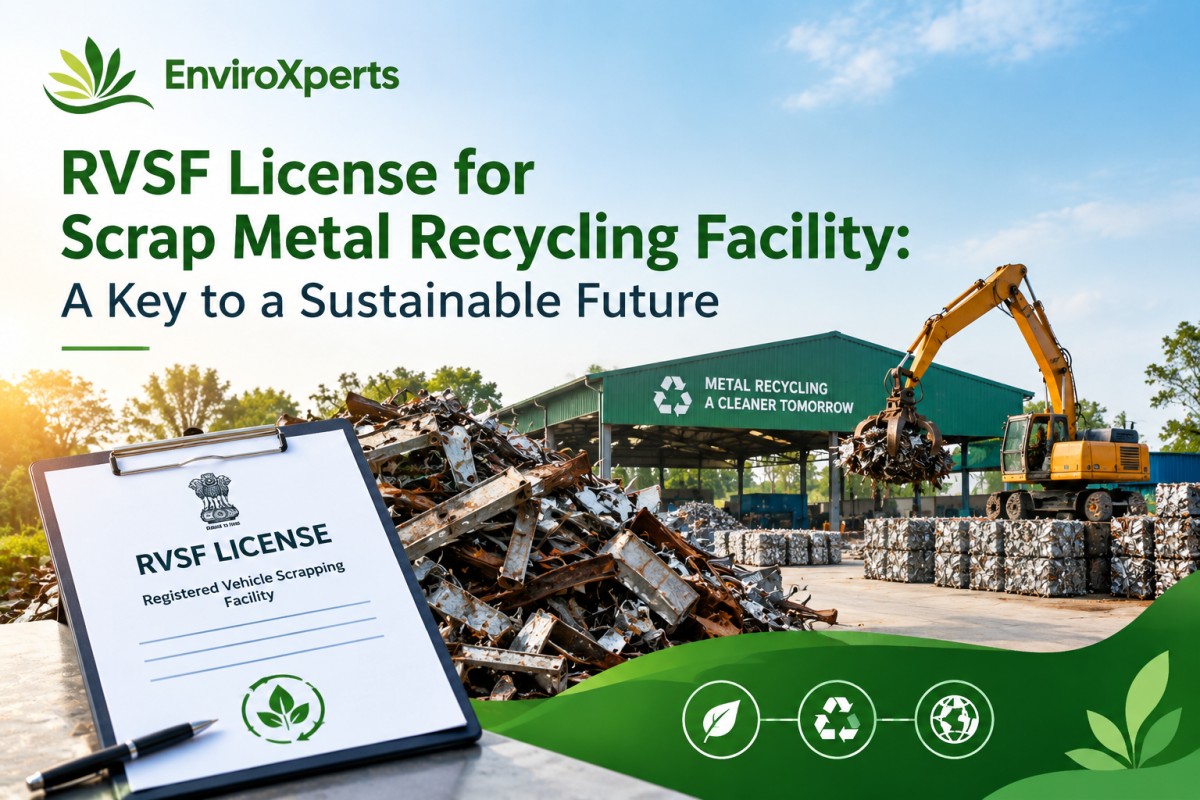
RVSF License for Scrap Metal Recycling Facility :-
India is taking big strides in industrialisation, which has directly skyrocketed the demand for metals. With a vision of keeping development sustainable, the use of scrap metals is rising, and hence businesses are looking for an RVSF license to run a scrap metal recycling facility. In the upcoming years, it is expected to have a compound annual growth rate of 7.3% in the metal recycling market, and scrap reuse becomes pivotal to India's growth.
Based on the guidelines of MoRTH (Ministry of Road Transport and Highways), the State Transport Department issues RVSF license to businesses once they register using the NSWS (National Single Window System). Metals like steel, aluminium, and copper, which are indispensable for infrastructure development, manufacturing, and consumer goods, are recovered from metal recycling.
Efficient management of end-of-life vehicles ensures more focus on sustainability by creating new dimensions of recycling and reuse in the vehicle scrapping sector.
What are Scrap Metals?
Scrap consists of recyclable materials that are by-products of manufacturing vehicles, buildings, consumer appliances, and industrial waste. Scrap and waste are different, as scrap has a significant monetary value and gives a boost to the circular economy. Scrap recovered from industrial waste is processed into new products using a well-structured process. Scrap metals are purified, recycled, and reused by various industries. These scrap metals are supplied by registered businesses having a valid RVSF license in India.
Types of Scrap Metal that can be recycled —
Scrap metal is generally divided into two categories: ferrous and non-ferrous. Both can be recycled, but it is important to understand the difference between the two before recycling scrap. Metals like steel are the most important recyclable ferrous metals. The only ferrous and non-ferrous metals that cannot be recycled are those containing lead or mercury due to their toxicity; hence, they need proper storage or decomposition. Uranium and plutonium have radioactive properties and cannot be recycled.
What is Vehicle Scrapping?
Scrap metals recovered from discarded vehicles can be of immense importance when we talk of recycling and reuse. Vehicle scrapping has both financial and environmental benefits. Scrap from vehicles is generally metal that’s no longer being used for its original purpose. Scrap metals include steel, iron, aluminium, copper, lead, zinc, etc.
What is the RVSF license?
RVSF license is a government-authorised certificate offering legal and scientific dismantling, recycling, and reuse of end-of-life vehicles under the MoRTH Vehicle Scrappage Policy. Businesses entering the scrap recycling sector need RVSF licenses for continuous, uninterrupted operations. RVSF licences regulate the scrapping sector and enable recycling discarded metals to give a boost to the circular economy.
Benefits of RVSF license registration:
- The registration is the main legal approval for the scrap metal business
- RVSF license registration legalises the facility to operate as a recognised scrapping unit.
- Once regulatory compliance is fulfilled, the business can connect to the official transport and environment framework.
- Firms having valid RVSF licenses are more credible and supported by vehicle owners, suppliers, and other related partners.
- It allows the scrap facilities to be audit-ready and demonstrate compliance when asked.
- Only government-approved Registered Vehicle Scrapping Facility (RVSF) can deregister the End-of-life vehicles on the Vahan portal and get a COD (certificate of deposit). This certificate allows a registration fee waiver on the purchase of a new vehicle.
- Vehicle manufacturers are advised to provide a certain amount of discount on the new vehicle purchase against the COD (certificate of deposit).
Documents required for the RVSF registration process in India:
Documents required for RVSF registration in India include:
- Duly filled Form I (available at NSWS portal)
- Certificate of Incorporation
- GST certificate
- Valid PAN
- Consent to Establish NOC (or proof of application)
- Certificate supporting a collection and dismantling centre as per CPCB guidelines.
- Proof of machinery required for depollution
- Consent to Operate from the concerned SPCB
- Quality certification undertaking (ISO 9001 or ISO 14001 or ISO 45001)
- Land agreement or proof of lease for 3 years
- Approved layout plan
- Recycle agreement
- Air pollution clearance
- TSDF (treatment, disposal and storage facility) agreement
Types of scrap vehicles valid for an RVSF License –
Before we get into the details of the RVSF licence, first we need to clearly understand the criteria for used vehicles that are categorised under scrap vehicles. The list comprises vehicles like –
- All central and State government vehicles older than 15 years fall under the category of scrap. They must be unregistered and directed to the Registered Vehicle Scrapping Facility (RVSF).
- Commercial vehicles in use for the past 15 years need Private Vehicles: 20 Years
New updates on RVSF 2026 regulations as per MoRTH Guidelines
- Cancellations of vehicle registration on the VAHAN database are accepted only when accompanied by a valid vehicle scrapping certificate issued by the VScrap portal.
- RVSF facilities with a valid RVSF license must upload the annual compliance reports. In case of failure, their registration will be cancelled. When not submitted within 3 months, there will be permanent cancellation.
- Law stating that companies that make products (like cars) must also ensure those products are safely recycled at the end of their lifespan.
- Original equipment manufacturers (OEM) as a part of their EPR (extended producer responsibility) must partner with RVSF facilities to meet the 8% target. This implies that at least 8% of the steel used in their production comes from recycled steel to promote recycling and reuse of scrap metal.
- RVSF License holders have an extended infrastructure duty that mandates them to maintain dismantling machinery and follow all the strict regulatory enforcement to pass annual audits.
Conclusion
India is one of the fastest-growing economies in the world, and to support positive economic growth, scrap metal recycling is an essential practice. A valid RVSF licence enables businesses to become an essential pillar for the sustainable development of the nation. EnviroXperts is a team of highly skilled professionals providing guidance on proper scrap management and RVSF licenses to help the infrastructure collaboration between producers and scrap facilities. We help businesses, traders, and manufacturers to increase their recycling capacity that forms an important part of EPR (extended producer responsibility). Scrap metal recycling reverses the adverse environmental impact and creates better employment opportunities.
Connect with EnviroXperts to explore RVSF license assistance, compliance assistance, and other services.
FAQs For Enviroxperts.com
-
Q. What is considered vehicle scrap metal?
Answer:- Vehicle scrap metal includes metal recovered from outdated, damaged, dismantled, or end-of-life
vehicles. Examples: steel, aluminium, copper, iron, etc.
-
Q. What is the New Vehicle Scrappage Policy in India?
Answer:- The vehicle scrappage policy 2021 establishes rules for old and unfit vehicles.
-
Q. When does my old Car need to be scrapped?
Answer:- Cars older than 15 years need to undergo a fitness test. If a car fails the fitness test, only then would it need to be scrapped as per the new Vehicle Scrappage Policy.
-
Q. Is recycling metal beneficial?
Answer:-Yes, it conserves non-renewable metals and boosts a circular economy by lowering manufacturing costs for new products like vehicles.
-
Q. Why RVSF license is mandatory for a legal vehicle scrap metal recycling facility in India?
Answer:- Scrapping through a government-authorised RVSF ensures safe, eco-friendly disposal of your ELV, in line with the Vehicle Scrappage Policy. It also helps avoid illegal practices, ensures proper recycling, and allows you to receive exclusive incentives on your next new vehicle purchase.
Related Blogs
Who are Enviroxperts and How They Help Businesses with Environmental Compliances?
Read More
How to Get an E-Waste License in India? A Complete Guide
Read More
Complete Guide to EPR Registration in India
Read More
How to Import Scrap Batteries in India and its Rules, License & Compliance Guide
Read More
How Registered Vehicle Scrapping Facility (RVSF) works in India
Read More
What EPR E waste Management rules says
Read More
What Tyre Waste Management Rules Says
Read More
What is EPR Battery
Read More